



In store
Why people still go
- Touch and feel
- Staff assistance
- Immediate availability
- Discounts
What slows them down
- Long checkout process
- Stock unavailability
- Difficulty locating products
Smart Cart
I designed a retail experience that helped shoppers decide faster across mobile screens, aisles, and a physical cart. Checkout is the last impression a store makes, and often its worst. On a typical peak-hour shift, 15-minute queues were the single largest driver of cart abandonment and in-store complaints.
Open the prototypeCheckout is the last impression a store makes, and often its worst.
I led the end-to-end design of a self-checkout experience for a startup that let customers scan, pay, and exit without a staffed line, rethinking not just the interface, but how trust, speed, and error-recovery had to work when no employee was standing there to catch a mistake.
The existing in-store checkout process had become a critical bottleneck in the retail customer journey. Long billing queues and slow transaction times increased customer wait times, leading to checkout abandonment, lower customer satisfaction, and missed revenue opportunities.
Inefficient checkout operations also reduced store throughput, limiting the retailer's ability to serve more customers during peak hours. As customer expectations shifted toward the speed and convenience of digital commerce, the traditional checkout experience no longer met evolving consumer needs.
First the store floor and the people on it, then the market around it.
Are people open to go for a Phygital Shopping Experience?
72% would likely use it. Nobody said unlikely.
In their words
Location of the product in the shop on the app
No long queues and fast checkout methods
Easy to get to know where one particular item is available in the store
The only improvement I want in physical shopping is to make billing procedure somewhat less time consuming.
Market researchKey findingsWhat each way of shopping gets right, and where it falls short. The cart keeps the wins.
Why people still go
What slows them down
Why people click
What lets them down
What excites them
What holds them back
A survey on how people shop in store and online, and what they'd want from both at once.
01Who answered
02How they shop
03In store vs online
Love it
Frustrated by
Love it
Frustrated by
04Ready for phygital
72% would likely use it. Nobody said unlikely.
05In their words
Location of the product in the shop on the app
No long queues and fast checkout methods
Easy to get to know where one particular item is available in the store
The only improvement I want in physical shopping is to make billing procedure somewhat less time consuming.
06Competitive analysis
Eight grocery brands, four things shoppers care about. Hover a dot for the note behind it.
| Brand | Locating products | Fast checkout | Real-time stock | Omnichannel |
|---|---|---|---|---|
| Nature's Basket | Mixed: Online search; in-store signage could improve | Mixed: In-app good, in-store moderate wait | Mixed: Not always accurate | Strong: Home delivery and BOPIS |
| Dorabjee's | Weak: Traditional layout; niche items hard to find | Weak: Slow during peak hours | Weak: Limited visibility online | Weak: Mostly physical stores |
| FoodHall | Strong: Intuitive layouts, trained staff | Strong: Seamless in store and in app | Mixed: Can lack precision for exotic items | Strong: Online, in-store pickup, experiential zones |
| Spencer's | Mixed: App search needs improvement | Mixed: In-app good, in-store long wait | Mixed: Not always consistent | Mixed: Lacks smooth transitions between channels |
| BigBasket | Strong: Online search and categories | Strong: Optimized in-app checkout | Strong: Real-time updates for stock and slots | Weak: Fully digital, no physical store |
| Reliance Fresh | Weak: Inconsistent organization; app lacks accuracy | Weak: Often slow in stores | Weak: Basic, not always reliable | Weak: Weak integration between app and store |
| Target | Strong: AR integration | Mixed: Concept of a smart cart | Weak: Inaccurate | Strong: BOPIS and home delivery |
| Walmart | Strong: Geo mapping | Strong: Pay through phone | Weak: Inaccurate | Strong: BOPIS and home delivery |
The gapNobody gets real-time stock right inside the store. The one brand that does, BigBasket, has no store at all.
07Themes and patterns
Everything we heard and read, grouped by the problem it points to. The colour shows where each note came from.
08Key findings
What the market research says each way of shopping gets right, and where it falls short. The cart has to keep the wins and fix the rest.
Why people still go
What slows them down
Why people click
What lets them down
What excites them
What holds them back
09SWOT analysis
What that means for a Smart Cart.
We synthesized research across user groups, behavioral patterns, and stakeholder input to identify the key patterns shaping the user experience.
Customers have to wait in long queues for checkout.
It takes a lot of effort and time for customers to find a product in store.
No continuity between the mobile app and the in-store experience.
The existing in-store checkout process had become a critical bottleneck in the retail customer journey.
How might weHow might we reduce the checkout time and increase footfall in store?
* All research data is based on figures up to 2025.
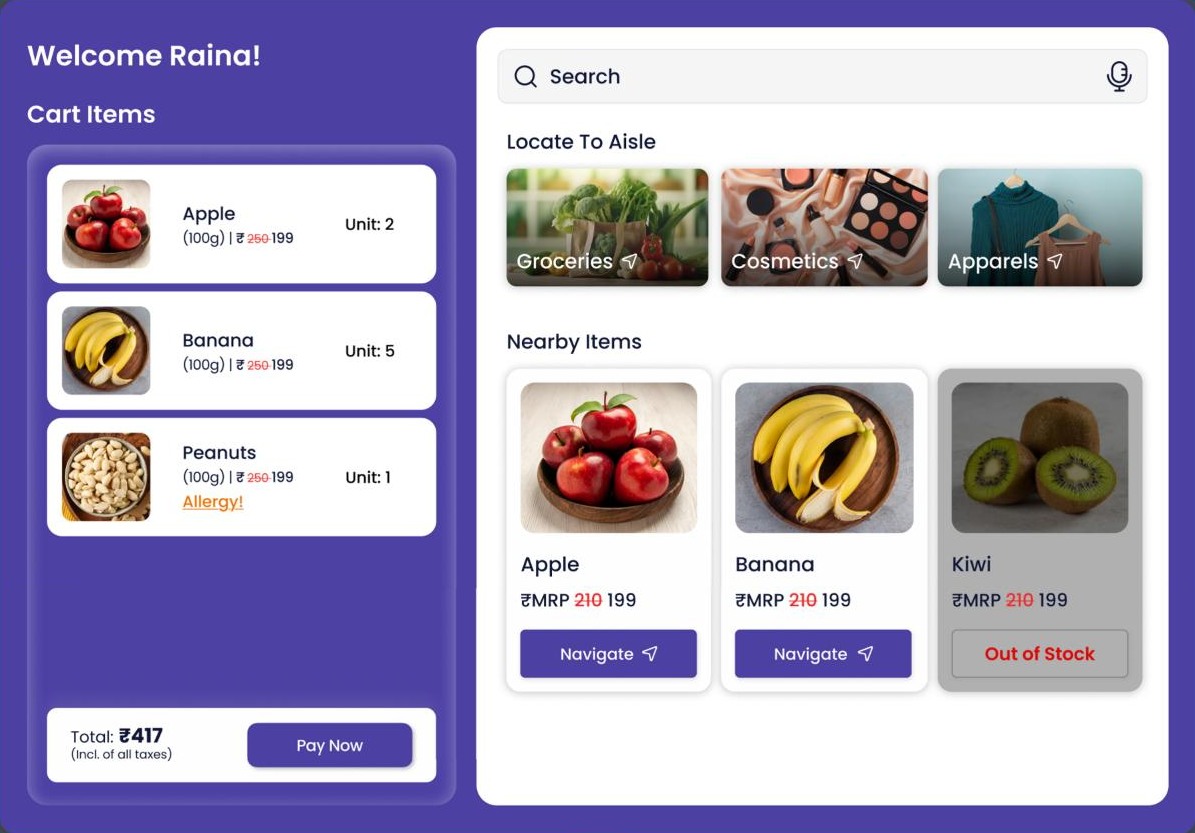
A Smart Cart that walks you to the shelf, keeps a live total, and checks you out right where you stand.
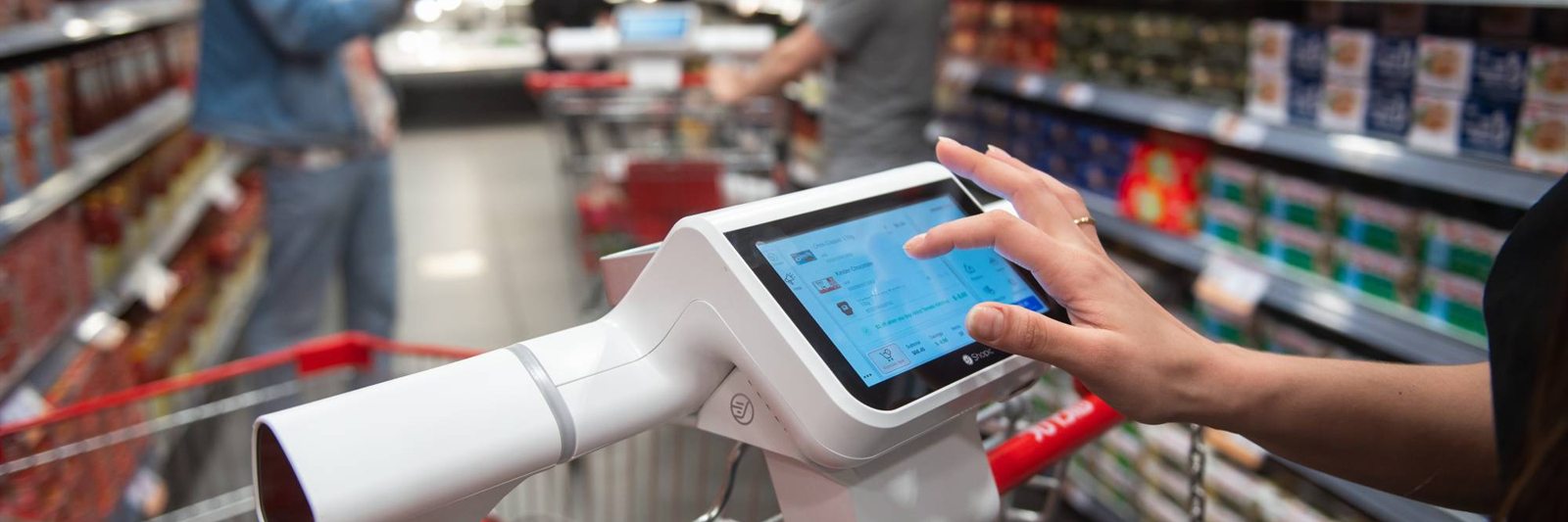
One screen on the trolley handle, and every part of it earns its place.
A shopper's run through the store: scan to start, let the cart guide you to your items, drop them in as the total updates, and pay right on the cart.
Shorter queues for shoppers, and a new way into retail for the business.
Drew attention from major retail players and new client interest, particularly in the object detection feature's potential for social media and influencer marketing.
The work became a strong proof point for the company's retail capabilities, opening the door to further opportunities in the space.
I would like to appreciate Raina's extended efforts, especially during client visits. I want to convey my best regards to all her efforts in enhancing "Omnichannel store" branding and working closely on the Smart Cart Use Case.
 Sriram VijayakumarProject Manager
I would like to recognize Raina's excellent contributions during her project and client visits. She played a key role in presenting "Omnichannel" use cases to stakeholders, showcasing innovative concepts. Thank you for your dedication and impactful contributions. Keep up the great work!
 Shreya DuttManager